
Selling Into Fear – Fixed Index Annuity (FIA)

Updated: May 23
In today’s environment, fear is no longer theoretical—it’s constant, visible, and emotionally powerful. From the ongoing war in Ukraine to the escalating conflict involving Iran, and even shifting political leadership and policy uncertainty, consumers are being bombarded with reasons to feel uneasy about their financial future.
Like these news headlines & articles:
The war in Ukraine continues to evolve with new military escalations
The Iran conflict has disrupted global energy markets and increased inflation risks
Oil prices have surged and fluctuated dramatically due to geopolitical tensions
These events may impact everyday costs like fuel, food, and overall economic stability
This constant cycle of negative headlines creates the perfect backdrop for one of the most effective financial sales strategies:
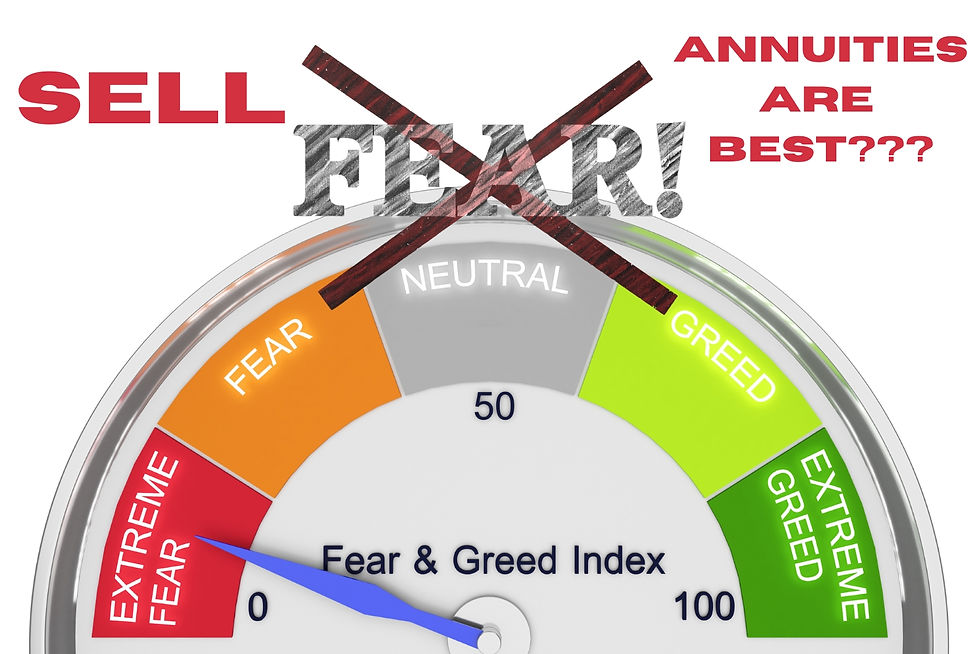
What Is “Selling Into Fear – Fixed Index Annuity (FIA)”?
Selling Into Fear – Fixed Index Annuity (FIA) is the practice of using real-world negative events—wars, market crashes, political instability—to push FIAs as a “safe” financial solution.
The messaging often sounds like:
“What happens if the market crashes again like during COVID?”
“With wars escalating globally, are you protected?”
“Political changes could impact your retirement—are you prepared?”
These statements aren’t entirely false—but they are selectively framed to trigger fear and urgency.
Why Today’s Environment Makes This So Effective
We are living in one of the most emotionally charged financial environments in decades:
Prolonged global conflicts (Ukraine, Middle East tensions)
Energy price volatility affecting inflation
Political party changes influencing tax and economic policies
Media cycles that amplify worst-case scenarios
This creates a powerful psychological effect:
When fear increases, rational analysis decreases.
And that’s where Selling Into Fear – Fixed Index Annuity (FIA) becomes highly effective.
How Fixed Index Annuities (FIAs) Work
To understand the sales strategy, you must understand the product.
Core Features:
Principal Protection: Typically a 0% floor against market losses
Index-Linked Returns: Based on an index like the S&P 500 (not direct investment)
Caps & Participation Rates: Limits on how much growth you receive
Surrender Periods: Often 7–10 years with penalties
What Is Often Not Fully Explained
1. Caps and Rates Can Change Annually
The upside you’re shown today is not guaranteed tomorrow.
2. Illustrations Are Hypothetical
They are not promises—they are projections based on assumptions.
3. Volatility-Controlled Indexes
Many FIAs use complex indexes designed to reduce volatility—but also reduce returns and come with conditional limitations.
4. High Commissions
These are often embedded and not clearly disclosed or openly discussed.
The Misleading Narrative Behind Fear-Based Selling
“Market Gains Without Risk”
This is the most common—and most misleading—pitch in Selling Into Fear – Fixed Index Annuity (FIA).
Reality:
You avoid losses, but you also limit gains
You trade growth potential for perceived safety
Over time, this can significantly impact long-term outcomes
Selective Use of Market Events
Sales professionals often highlight:
2008 financial crisis
COVID-19 crash
Current geopolitical conflicts
But they rarely show:
Long-term market recovery trends
Opportunity cost of being capped
Full-cycle investment comparisons
IRR Analysis as a start: The Reality Check
When you run a true Internal Rate of Return (IRR) on many FIAs:
Returns are often far lower than illustrated
Long surrender periods dilute performance
Liquidity restrictions reduce flexibility
This is where emotion meets reality—and often, the numbers tell a different story.
The Hidden Cost: Surrender Charges
Most FIAs include:
7–10 year surrender periods
Declining penalty schedules
This means:
You are locked in
Exiting early can be costly
Flexibility is limited during uncertain times
Ironically, the same uncertainty used to sell the product is what you lose flexibility to respond to.
Why the Free-Look Period Matters More Than Ever
The 10–30 Day Free-Look Period is one of the most important consumer protections.
It exists because:
These products are complex
Sales pressure can influence decisions
Full understanding takes time
Use this period to:
Step away from the sales environment
Review the contract independently
Seek a second opinion
The Role of Political and Economic Narratives
Today’s sales environment is not just about markets—it’s about narratives:
Political party changes → “taxes may rise”
Wars → “markets may crash”
Inflation → “your savings are at risk”
These narratives are powerful—but they are also cyclical and often temporary.
Making permanent financial decisions based on temporary fear is where mistakes happen.
Why a Second Opinion Is Critical
A proper independent review should:
Analyze the true IRR, Present Value, Future Value, Total Rate of Return, etc.
Break down caps, spreads, and participation rates
Evaluate suitability vs. alternatives
Identify conflicts of interest
For professionals (CPAs, attorneys, advisors):
Your clients are being influenced by fear-based narratives—your role is to bring clarity.
When FIAs May Be Appropriate
Despite the concerns, FIAs can make sense in specific situations:
Extremely conservative investors
Those prioritizing principal protection over growth
Certain structured income strategies
But they should never be:
Sold through fear
Purchased under pressure
Accepted without full analysis
Final Thoughts
Selling Into Fear – Fixed Index Annuity (FIA) is not about the product alone—it’s about timing, emotion, and narrative.
In times like these—when global conflict, economic uncertainty, and political shifts dominate headlines—the risk isn’t just market volatility.
It’s making financial decisions based on fear instead of facts.
Frequently Asked Questions (FAQ)
1. What is “Selling Into Fear – Fixed Index Annuity (FIA)”?
It’s a sales strategy that uses fear from market downturns, wars, or economic uncertainty to promote FIAs as a safe solution.
2. Are FIAs affected by global events like wars?
Indirectly, yes. While they don’t lose value due to market declines, economic conditions can impact crediting rates and performance.
3. Why do sales increase during uncertain times?
Fear increases demand for “safe” products, making consumers more receptive to FIA sales pitches.
4. What is the biggest downside of FIAs?
Limited upside due to caps, long surrender periods, and often lower-than-expected returns when analyzed using IRR. Also, when it comes to lifetime payouts, an Present Value (PV), Future Value (FV) and Toal Rate of Return valuation is also a must!
5. How long are surrender periods?
Typically 7–10 years, with penalties for early withdrawals.
6. What should I do during the Free-Look Period?
Review the policy independently, run an comparative analysis, and seek a second opinion.
7. Are FIA returns guaranteed?
No. Only the principal protection is guaranteed. Returns depend on caps, participation rates, and index performance.
8. Why is a second opinion important?
It removes sales bias and provides a clear, objective evaluation of whether the product fits your financial goals.


