
Selling Into Fear – Indexed Universal Life (IUL)

Updated: May 30
In uncertain times, fear becomes one of the most powerful drivers of financial decisions. It’s also one of the most effective tools used—intentionally or unintentionally—by insurance sales professionals. This is where the strategy known as “Selling Into Fear – Indexed Universal Life (IUL)” takes center stage.
For both consumers and financial professionals, understanding how fear-based selling works—and how Indexed Universal Life (IUL) is often positioned as a “solution”—is critical to making informed, rational decisions.
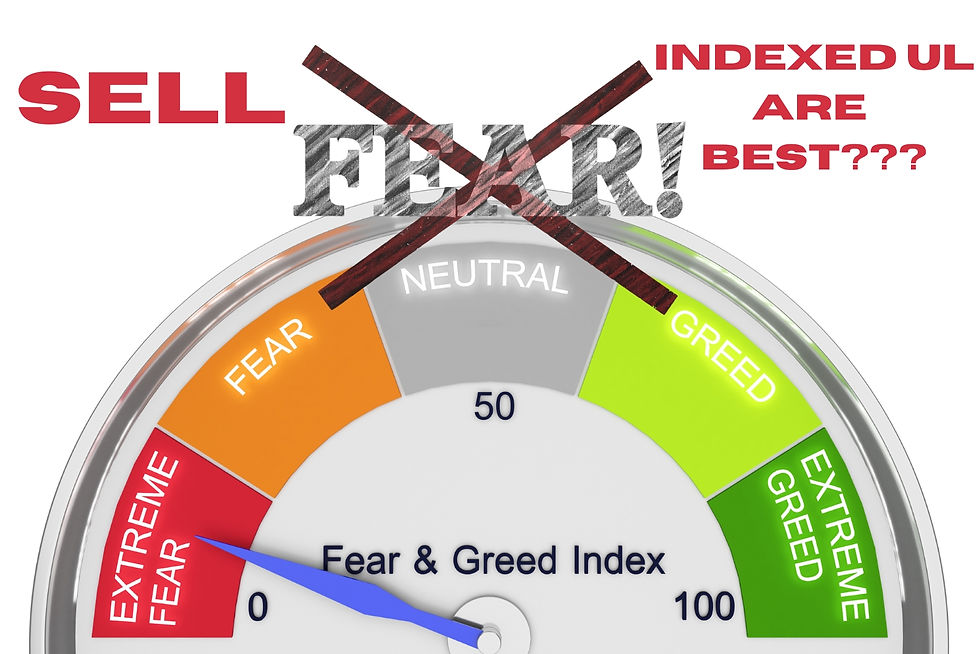
What Is “Selling Into Fear – Indexed Universal Life (IUL)”?
“Selling into fear” is a sales approach that leverages real-world uncertainty—market crashes, economic instability, rising taxes, and geopolitical conflicts—to create urgency.
You’ll often hear references to events like:
The COVID-19 pandemic
The 2008 Financial Crisis
The Russian invasion of Ukraine
Ongoing tensions involving Iran
These events are real and impactful—but when selectively presented, they can create a narrative that pushes consumers toward one conclusion:
“The market is dangerous. You need protection. This product solves that.”
That product is often Indexed Universal Life (IUL).
How IUL Is Marketed as the “Better Investment”
A common theme in Selling Into Fear – Indexed Universal Life (IUL) is positioning the policy as a superior alternative to traditional investments—especially compared to an S&P 500 index ETF because it has no downside market lost.
Sales narratives often sound like this:
“You get stock market gains without the risk.”
“You’ll never lose money because of the 0% floor.”
“It grows tax-free and can be accessed tax-free.”
“Plus, it includes life insurance protection.”
On the surface, it sounds like the perfect hybrid: investment + protection + tax advantages.
But this is where clarity is often replaced with salesmanship.
The Critical Misunderstanding: IUL Is NOT an Investment
Let’s be direct: Indexed Universal Life (IUL) is not an investment.
It is a life insurance product with a cash value component that is linked to an index for interest crediting—not direct investment participation.
Unlike an S&P 500 ETF:
You are not invested in the market
You do not receive dividends
Your returns are limited by caps, participation rates, and spreads
Comparing IUL to an index ETF is not apples-to-apples—it’s more like comparing a multi-layered insurance contract to a low-cost market investment vehicle.
Why the “Better Than the Market” Narrative Works
This narrative is powerful because it combines:
Fear of loss (market downturns)
Desire for growth (market upside)
Tax appeal (tax-free income)
Security (life insurance protection)
It tells a story that feels complete.
But what’s often missing is a full explanation of cost, trade-offs, and long-term performance reality.
The Real Cost of IUL (Often Not Clearly Disclosed)
One of the biggest issues with Selling Into Fear – Indexed Universal Life (IUL) is the lack of transparency around costs.
1. High Internal Costs
Cost of insurance (COI)
Administrative fees
Rider charges
These are built into the policy and significantly reduce performance—especially in the early years.
2. Long Break-Even Period
Most IUL policies:
Take 10–15+ years to break even
Require consistent funding to stay on track
During this period, the policyholder may see little to no meaningful growth.
3. Lower Long-Term Returns
Even under favorable assumptions:
Long-term cash value Internal Rate of Return (IRR) often lands around 3%–4%
Compare that to the historical long-term performance of the S&P 500, and the gap becomes clear—especially when factoring in fees and lost compounding.
4. “Tax-Free” Loans Are Not Free
Accessing income from an IUL typically involves:
Policy loans
Loan interest
Reduced policy performance
In some cases, the cost of borrowing against your own policy can exceed the taxes you were trying to avoid.
The Flexibility That Works Against You
IUL policies are often described as “flexible,” but that flexibility can work against the policyholder:
Caps can be lowered
Participation rates can change
Index options can be modified
Costs can increase over time
All of this is controlled by the insurance company—not the policyholder.
Commissions and Incentives: The Elephant in the Room
IUL is one of the highest-commission products in the insurance industry. Yet many consumers are never told:
How much the agent earns
How compensation influences recommendations
How policy design can be optimized for commission
If full transparency were standard, the conversation around Selling Into Fear – Indexed Universal Life (IUL) would look very different.
The 10–30 Day Free-Look Period: A Critical Safeguard
Every life insurance policy includes a free-look period (typically 10–30 days).
This allows you to:
Cancel the policy
Receive a full refund
Reevaluate without pressure
This is your opportunity to step away from the sales environment and ask:
“Do I fully understand what I bought—and why?”
Why a Second Opinion Is Essential
Before committing to an IUL policy, consider:
Requesting an IRR (Internal Rate of Return) report
Reviewing all policy charges and expenses
Comparing alternatives (including simple market investments)
Getting an independent, non-commission-based review
A second opinion replaces emotion with analysis.
Key Takeaways
Selling Into Fear – Indexed Universal Life (IUL) is a powerful sales approach built on emotional triggers
IUL is often positioned as a superior “investment,” but it is not an investment
Costs, charges, and long-term returns are frequently underexplained
Comparing IUL to an S&P 500 ETF is misleading
Transparency, education, and independent review are critical
FAQs: Selling Into Fear – Indexed Universal Life (IUL)
1. Why is IUL often compared to the S&P 500?
Because it’s linked to an index for interest crediting, but this comparison is misleading since you are not directly invested in the market and it has capped crediting.
2. Is IUL a good investment alternative?
No. It is not designed to be an investment. It is an insurance product with different objectives and cost structures. However, a Variable Universal Life (VUL) would be a better alternative.
3. What is the typical return of an IUL policy?
Long-term IRR often falls in the 3%–4% range, depending on assumptions and costs.
4. Why don’t agents clearly explain the costs?
Costs are complex and can make the policy less attractive, especially when compared to simpler investment options.
5. Are IUL returns guaranteed?
No. While there may be a 0% floor, returns depend on caps, participation rates, and insurer decisions.
6. What is the biggest risk of buying an IUL?
Misunderstanding how it works—especially costs, loan mechanics, and long-term sustainability.
7. Can I cancel after buying an IUL?
Yes, during the free-look period (10–30 days) you can cancel for a full refund.
8. Should I get a second opinion before buying?
Absolutely. A second opinion can uncover costs, assumptions, and alternatives that may not have been presented.
Final Thought
Fear can be persuasive—but it should never be the basis of a financial strategy.
Understanding the truth behind Selling Into Fear – Indexed Universal Life (IUL) allows both consumers and professionals to move beyond the sales narrative—and make decisions grounded in transparency, logic, and long-term value.


